
Vận Hành Khách Sạn
Quy Trình Dọn Phòng Khách Sạn Chuẩn 4–5 Sao: Bí Quyết Nâng Tầm Trải Nghiệm Khách Hàng
Trong ngành dịch vụ khách sạn, sự khác biệt giữa một cơ sở lưu trú bình dân và một khách sạn hạng sang thường nằm ở những chi tiết nhỏ nhất. Một căn phòng sạch bóng, một bộ chăn ga trắng muốt phẳng lỳ và mùi hương tinh tế không chỉ là kết quả của sự chăm chỉ, mà là thành quả của một quy trình dọn phòng nghiêm ngặt.
Đối với các khách sạn 4–5 sao, việc duy trì tiêu chuẩn buồng phòng ổn định là bài toán sống còn. Khi du khách ngày càng khắt khe hơn về an toàn vệ sinh và sự sang trọng, bộ phận Housekeeping cần một “kim chỉ nam” để vận hành trơn tru.
Tại Jolie’Fam, chúng tôi tin rằng đồ vải là “linh hồn” của phòng ngủ, nhưng chính quy trình dọn phòng chuyên nghiệp mới là đôi bàn tay thổi hồn vào không gian đó. Bài viết này sẽ cung cấp cho bạn cái nhìn toàn diện từ khâu chuẩn bị đến những tiêu chuẩn thay đồ vải khắt khe nhất.
Chuẩn Bị Trước Khi Thực Hiện Quy Trình Dọn Phòng
Sự chuyên nghiệp bắt đầu trước khi nhân viên đặt chân vào phòng khách. Giai đoạn chuẩn bị tốt giúp tiết kiệm 15-20% thời gian làm việc và giảm thiểu các sai sót không đáng có.

1. Kiểm tra ngoại hình và tác phong
Nhân viên buồng phòng là người đại diện cho sự sạch sẽ. Đồng phục phải phẳng, bảng tên cài đúng vị trí và đặc biệt là đôi tay luôn được giữ vệ sinh. Trong tiêu chuẩn cao cấp, nhân viên thường được yêu cầu đeo găng tay chuyên dụng khi xử lý đồ vải sạch để tránh dấu vân tay hoặc mồ hôi bám vào sợi vải Cotton.
2. Chuẩn bị xe đẩy khoa học
Một chiếc xe đẩy Housekeeping chuẩn 5 sao cần được sắp xếp theo nguyên tắc:
– Tầng trên cùng: Amenities (bàn chải, lược, xà phòng), hóa chất tẩy rửa chuyên dụng.
– Tầng giữa: Đồ vải sạch (ga giường, vỏ chăn, vỏ gối, khăn tắm). Đồ vải cần được gấp nếp đồng nhất và quay mặt nếp gấp ra ngoài để dễ lấy.
– Tầng dưới: Các vật dụng nặng hơn như nước đóng chai, giấy vệ sinh.
– Túi hai bên: Một bên đựng đồ vải bẩn, một bên đựng rác.
What 10DollarDepositCasinos Reveals About Low Deposit Gambling Trends in New Zealand
New Zealand’s online gambling market has undergone a significant structural shift over the past several years, driven not by high-roller culture but by a growing segment of players who prefer cautious, low-commitment entry points into digital casino environments. The $10 deposit threshold has emerged as a particularly meaningful benchmark in this context — low enough to be accessible to a wide demographic, yet substantial enough to unlock meaningful gameplay and bonus eligibility. Examining how platforms and research sites document this trend reveals a great deal about how New Zealand players actually engage with online gambling, what they prioritize, and how the regulatory environment shapes their choices. Understanding the mechanics and motivations behind low deposit gambling is increasingly relevant not just for players but for analysts, regulators, and operators trying to make sense of one of the Pacific region’s most distinctive digital entertainment markets.
The Economic and Demographic Logic Behind Low Deposit Thresholds
New Zealand has a relatively small population — approximately 5.1 million people as of 2024 — yet maintains a disproportionately active online gambling community. This is partly a function of geography. With limited land-based casino infrastructure outside of Auckland’s SkyCity and a handful of regional venues, digital platforms have filled a significant gap in entertainment access, particularly for players in smaller cities and rural areas. The result is a player base that is broadly distributed across income levels and gaming experience, which creates natural demand for deposit structures that don’t assume large disposable income or high risk tolerance.
The $10 deposit minimum sits at an interesting intersection. For casual players, it represents a genuine trial — enough to test a platform’s interface, game variety, and payment processing speed without meaningful financial exposure. For more experienced players, it often functions as a tool for bankroll management, allowing them to maintain activity across multiple platforms rather than concentrating funds in a single account. This behavioral pattern — spreading small deposits across several casinos — has been documented in player forums and industry surveys since at least 2019, and it reflects a level of financial discipline that contradicts the popular image of reckless online gambling.
New Zealand’s economic landscape also plays a role. The country experienced significant cost-of-living pressures from 2021 onward, with inflation reaching a three-decade high of 7.3% in mid-2022. Discretionary spending contracted across multiple categories, and entertainment budgets were among the first to tighten. In this environment, the ability to participate in online casino gaming for $10 rather than $50 or $100 became a meaningful distinction. Operators who recognized this early and adjusted their minimum deposit structures accordingly retained players who might otherwise have exited the market entirely during periods of financial pressure.
Age demographics also contribute to the picture. Younger New Zealand adults — particularly those in the 25 to 35 bracket — have grown up with mobile-first digital experiences and tend to approach gambling with a transactional, value-conscious mindset. They are more likely to research bonus terms before depositing, more likely to compare platforms before committing funds, and more likely to abandon a site that offers a poor user experience regardless of its promotional generosity. Low deposit thresholds align naturally with this research-before-committing approach, because they reduce the cost of discovering that a platform doesn’t meet expectations.
How Research Platforms Document the Low Deposit Landscape
One of the more telling developments in New Zealand’s online gambling ecosystem has been the growth of specialized comparison and information platforms focused specifically on low deposit options. These sites serve a function that goes beyond simple directory listing — they effectively map the market by tracking which operators accept small deposits, which payment methods support them, and how bonus structures interact with minimum deposit requirements. The existence and growth of such platforms is itself a market signal, indicating that demand for this information is substantial enough to support dedicated editorial operations.
The data aggregated by platforms of this type reveals several consistent patterns. First, the number of internationally licensed operators accepting NZD deposits of $10 or less has grown steadily since 2018, when a handful of Malta Gaming Authority and UK Gambling Commission licensees began targeting the New Zealand market more deliberately. By 2022, the range of viable options had expanded considerably, with Curaçao-licensed operators also competing aggressively for New Zealand players through promotional structures designed around low entry points. Second, payment method availability has become a critical differentiator at the low deposit level. Methods like Poli, Neosurf, and various e-wallet solutions have gained traction specifically because they process small transactions efficiently and without the currency conversion fees that can make a $10 deposit effectively cost $11 or $12 when processed through certain international card networks.
Sites like https://www.10-dollar-deposit-casinos.com/ aggregate this kind of operational detail in ways that help players navigate a market that lacks centralized regulatory oversight at the national level, given that New Zealand’s Gambling Act 2003 does not directly regulate offshore online operators. This regulatory gap means that players rely heavily on third-party information sources to assess platform legitimacy, bonus fairness, and withdrawal reliability — functions that in more heavily regulated markets might be served by official government resources or mandated operator disclosures.
The editorial methodology used by serious comparison platforms in this space has also evolved. Early iterations of these sites — circa 2015 to 2018 — tended to function primarily as affiliate directories with limited analytical depth. More recent versions apply structured evaluation criteria: testing actual deposit and withdrawal processes, documenting wagering requirement calculations with specific examples, and tracking how operators respond to player complaints over time. This shift toward more rigorous documentation reflects both increased competition among comparison platforms and increased sophistication among the players who use them. A New Zealand player researching a $10 deposit casino in 2024 typically wants to know not just whether the minimum deposit is $10, but whether the welcome bonus applies to that deposit amount, what the wagering multiplier is, which games contribute to wagering requirements, and how long withdrawals typically take. Platforms that answer these questions with specificity rather than generality have become the more trusted resources in the space.
Regulatory Context and Its Effect on Low Deposit Gambling in New Zealand
New Zealand’s regulatory framework for online gambling is notably different from those of Australia, the United Kingdom, or most European jurisdictions. The Gambling Act 2003 established a legal structure focused primarily on land-based gambling, with the New Zealand Racing Board and a small number of licensed domestic operators permitted to offer specific online products. The Act does not explicitly criminalize New Zealand residents for accessing offshore online casinos, and no individual has been prosecuted for doing so. This creates a legal gray zone that has persisted for over two decades, during which the offshore online gambling market serving New Zealand players has grown substantially without meaningful domestic regulatory intervention.
The Department of Internal Affairs, which administers gambling regulation in New Zealand, has periodically acknowledged the limitations of the current framework. A 2020 review flagged concerns about problem gambling risks associated with offshore operators who are not subject to New Zealand’s responsible gambling requirements, including mandatory contributions to the Problem Gambling Foundation and adherence to the Gambling Harm Minimisation framework. However, legislative reform has moved slowly, and as of 2024, no comprehensive online gambling licensing regime has been enacted. This stands in contrast to Australia, which implemented the Interactive Gambling Act in 2001 and has progressively tightened enforcement against unlicensed offshore operators, most recently through the Australian Communications and Media Authority’s blocking regime.
The regulatory vacuum has practical consequences for low deposit gambling specifically. Without domestic licensing requirements, offshore operators serving New Zealand are not required to implement the kinds of deposit limit tools, self-exclusion systems, or affordability checks that have become standard in regulated markets like the UK. A player depositing $10 at an offshore casino faces no mandatory prompts to set spending limits, no connection to New Zealand’s national self-exclusion register, and no requirement that the operator verify that the deposit is affordable relative to the player’s financial circumstances. This doesn’t mean that all offshore operators ignore responsible gambling — many voluntarily implement tools in line with their home jurisdiction’s requirements — but the absence of mandated standards creates significant variation in player protection levels across the market.
From a market structure perspective, the lack of regulation has also allowed a wider range of operators to compete for New Zealand players than would exist under a licensing regime. This benefits players in terms of choice and competitive pricing — bonus offers tend to be more generous in unregulated markets because operators face no cap on promotional expenditure — but it also increases the risk of encountering operators with poor financial stability or inadequate dispute resolution processes. The $10 deposit threshold, paradoxically, may serve as a modest form of consumer protection in this environment. Players who limit initial deposits to small amounts while assessing a platform’s reliability are effectively self-insuring against the risk of operator failure or withdrawal refusal.
There is also an interesting interaction between low deposit thresholds and problem gambling research in New Zealand. The Problem Gambling Foundation’s annual data consistently shows that problem gambling in New Zealand is more strongly associated with electronic gaming machines — pokies — in pubs and clubs than with online casino activity. However, researchers have noted that online gambling’s accessibility, including the ability to deposit and play from a smartphone at any hour, creates risk profiles that differ from land-based gambling. Whether low deposit options mitigate or exacerbate these risks is genuinely contested in the literature. Some researchers argue that low thresholds encourage more frequent small deposits that collectively represent significant expenditure; others contend that they enable more controlled participation by players who would otherwise face all-or-nothing decisions about larger deposits.
Bonus Structures, Wagering Requirements, and the Real Value of a $10 Deposit
One of the most practically important things that research into low deposit casinos reveals is the significant gap between promotional headline figures and the actual value available to players depositing at the minimum threshold. This gap is particularly pronounced in New Zealand’s offshore market, where bonus competition is intense and promotional terms are frequently designed to attract deposits while limiting actual bonus conversion.
A typical welcome bonus structure in this market might advertise a 100% match up to $500, which sounds generous but requires a $500 deposit to access in full. A player depositing $10 receives a $10 bonus — a fraction of the advertised maximum. More importantly, that $10 bonus is typically subject to wagering requirements of 30x to 50x, meaning the player must wager $300 to $500 in real money before the bonus converts to withdrawable funds. For a $10 depositor, this creates a mathematical situation where the bonus is effectively inaccessible in practice — the required wagering volume exceeds what a $10 bankroll can realistically sustain without additional deposits.
Some operators have recognized this disconnect and developed bonus structures more specifically suited to low deposit players. These include no-deposit bonuses triggered by account registration, free spin packages with lower wagering requirements, and cashback offers that return a percentage of losses rather than matching deposits. The 10DollarDepositCasinos research framework specifically evaluates whether bonus structures are genuinely accessible at the minimum deposit level, rather than simply confirming that a $10 deposit is technically accepted. This distinction matters enormously for players who are making decisions based on bonus value as well as deposit accessibility.
Payment processing at the $10 level also introduces practical complications that are less visible at higher deposit amounts. Some payment providers impose minimum transaction fees that represent a significant percentage of a $10 transaction — a $1.50 processing fee is 15% of a $10 deposit, which immediately erodes the value of any promotional offer. Credit card processing in particular can be expensive at low transaction volumes, which is one reason why e-wallets and prepaid card solutions like Neosurf have gained popularity among low deposit players in New Zealand. Neosurf vouchers, available at convenience stores and petrol stations across New Zealand, allow players to fund casino accounts without bank involvement and without per-transaction fees, making them particularly well-suited to the $10 deposit use case.
Withdrawal minimums present another layer of complexity. An operator might accept a $10 deposit but impose a $20 or $30 minimum withdrawal, which means a player who deposits $10, wins modestly, and tries to withdraw faces a structural barrier. They must either deposit more to meet the withdrawal threshold or continue playing until their balance either grows to the minimum or is depleted. This asymmetry between deposit and withdrawal minimums is a consistent finding in low deposit casino research and represents one of the more significant practical disadvantages of operating at the minimum deposit level. Platforms that document this discrepancy provide genuine informational value, because it is rarely disclosed prominently in operator terms and conditions.
Game contribution rates add a further layer of complexity to the value calculation. Standard slot games typically contribute 100% toward wagering requirements, but table games — blackjack, roulette, baccarat — often contribute 10% or less, and some operators exclude them entirely from bonus wagering. A player who deposits $10, receives a $10 bonus, and prefers table games may find that their preferred games contribute nothing toward clearing the bonus, effectively making the bonus irrelevant to their actual gambling activity. Understanding these contribution structures requires detailed reading of terms and conditions that are often lengthy, technically written, and not prominently displayed during the deposit and bonus acceptance process.
New Zealand’s low deposit gambling market, as documented by platforms like 10DollarDepositCasinos and reflected in broader industry data, ultimately tells a story about a player population that is more financially cautious, more analytically engaged, and more aware of the gap between promotional promises and actual value than the stereotype of the reckless online gambler would suggest. The persistence and growth of the $10 deposit segment — even as some operators have raised minimums to $20 or $30 to reduce payment processing overhead — indicates that this cautious approach to online gambling is not a temporary phenomenon but a durable feature of how New Zealand players engage with digital casino entertainment. Whether future regulatory reform will formalize protections for this segment, or whether the offshore market will continue to self-regulate through competition and third-party oversight, remains an open question that will significantly shape the next decade of online gambling in New Zealand.
3. Kiểm tra báo cáo tình trạng phòng
Trước khi bắt đầu, nhân viên cần nắm rõ danh sách phòng ưu tiên (phòng VIP, phòng khách yêu cầu dọn sớm). Điều này nằm trong tổng thể Cẩm Nang Vận Hành Buồng Phòng Khách Sạn Chuẩn Chuyên Nghiệp Từ A–Z mà các quản lý cần đặc biệt lưu tâm.
Quy Trình Dọn Phòng Trống Sẵn Sàng Đón Khách
Phòng trống (Vacant Clean) là loại phòng đã dọn sạch nhưng cần được kiểm tra lại trước khi bàn giao cho khách mới. Đây là bước quan trọng để đảm bảo không có bụi bẩn tích tụ trong thời gian phòng chờ khách.

– Nguyên tắc dọn dẹp: Thực hiện theo chiều kim đồng hồ và từ trên xuống dưới. Điều này đảm bảo bụi bẩn không rơi xuống những khu vực đã làm sạch.
– Thông thoáng không khí: Mở cửa sổ (nếu có) hoặc bật hệ thống thông gió để loại bỏ mùi ẩm mốc.
– Kiểm tra thiết bị: Thử bật/tắt bóng đèn, điều hòa, TV và két sắt. Một chiếc bóng đèn cháy hay điều hòa không mát sẽ ngay lập tức làm giảm điểm trải nghiệm của khách.
– Lau bụi bề mặt: Sử dụng khăn Microfiber mềm để lau các bề mặt gỗ và gương kính. Tại Jolie’Fam, chúng tôi cung cấp các dòng khăn lau chuyên dụng từ sợi Microfiber có khả năng hút bụi cực tốt mà không để lại xơ vải.
Tiêu Chuẩn Thay Và Sắp Xếp Đồ Vải Khách Sạn
Đồ vải chính là “điểm chạm” trực tiếp nhất giữa khách hàng và khách sạn. Trong quy trình dọn phòng 4–5 sao, việc thay đồ vải được ví như một nghi thức tinh tế.
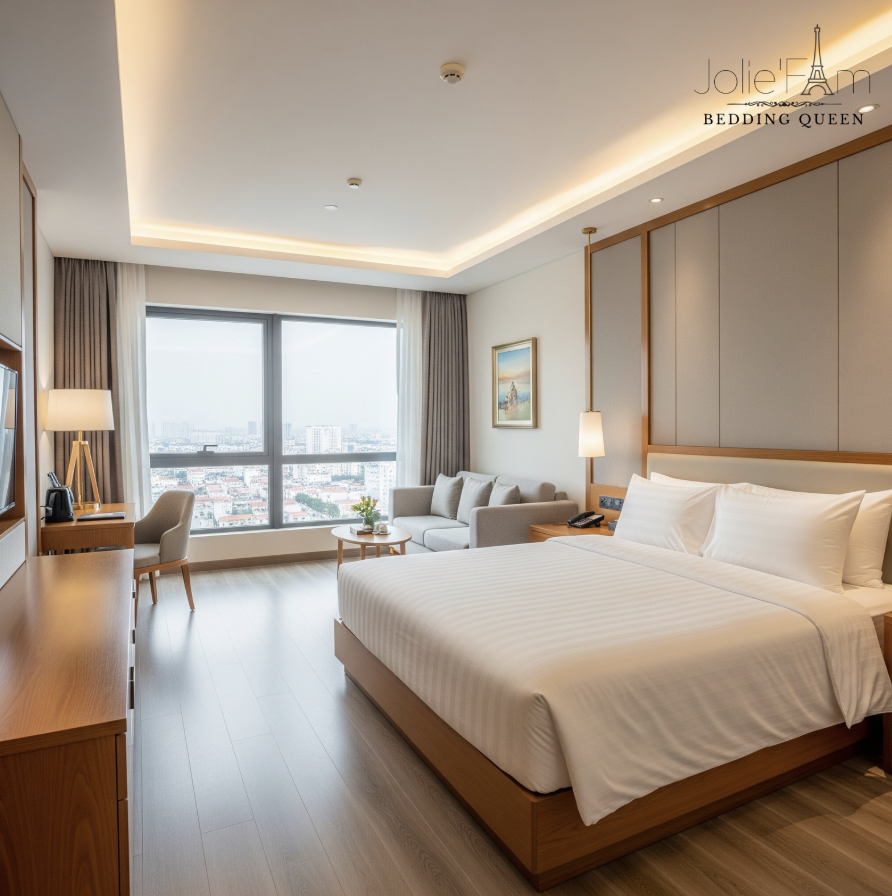
1. Quy trình thay ga giường
– Lột đồ bẩn: Tuyệt đối không tung ga giường trong không khí để tránh bụi và vi khuẩn phát tán. Cuộn tròn đồ bẩn và cho vào túi đựng chuyên dụng.
– Kiểm tra bảo vệ đệm: Đảm bảo tấm bảo vệ đệm luôn sạch và phẳng.
– Trải ga giường: Sử dụng vải Cotton T300 hoặc T400 của Jolie’Fam để đảm bảo độ trắng sáng và mềm mại. Ga phải được căng phẳng, góc giường được gấp theo kiểu “phong bì” (Mitered Corner) chuẩn 45 độ.
– Lồng vỏ chăn (Duvet): Ruột chăn phải được đẩy sát vào 4 góc vỏ chăn, không bị vón cục.
2. Tiêu chuẩn sắp xếp gối và khăn
– Gối: Miệng vỏ gối phải quay vào trong (đối diện nhau) để giấu đi phần ruột gối bên trong. Gối được dựng đứng hoặc đặt nằm tùy theo phong cách set-up của khách sạn.
– Khăn tắm: Khăn phải được gấp vuông vức, logo khách sạn (nếu có) hướng ra ngoài. Sợi vải phải bông xốp, không có mùi hóa chất tẩy rửa mạnh.
Những Lưu Ý Quan Trọng Khi Thực Hiện Quy Trình Dọn Phòng
Để đạt được sự hoàn hảo, bộ phận Housekeeping cần lưu ý những “quy tắc vàng” sau:

– Tôn trọng quyền riêng tư: Luôn gõ cửa 3 lần và xướng tên bộ phận trước khi vào. Nếu khách treo biển “Do Not Disturb” (DND), tuyệt đối không được làm phiền.
– Xử lý đồ thất lạc (Lost & Found): Mọi đồ vật khách để quên, dù là nhỏ nhất như sạc điện thoại, đều phải được niêm phong và ghi chép cẩn thận.
– An toàn hóa chất: Sử dụng đúng loại hóa chất cho từng bề mặt (da, gỗ, đá marble). Việc dùng sai hóa chất có thể gây hư hỏng tài sản đắt giá của khách sạn.
– Kiểm soát chất lượng đồ vải: Trong quá trình thay đồ, nếu phát hiện vải bị sờn, rách hoặc ố vàng, nhân viên phải loại bỏ ngay lập tức và gửi về bộ phận giặt là để xử lý riêng. Những bộ chăn ga Cotton cao cấp của Jolie’Fam với độ bền sợi cao sẽ giúp giảm thiểu tỷ lệ lỗi này đáng kể.
Ứng Dụng Công Nghệ Để Tối Ưu Quy Trình Dọn Phòng
Trong thời đại số, việc quản lý buồng phòng bằng sổ tay đã dần trở nên lạc hậu. Các khách sạn 4–5 sao hiện nay đều ứng dụng phần mềm quản lý (PMS) để tối ưu hóa quy trình.

– Cập nhật trạng thái phòng Real-time: Ngay khi nhân viên hoàn tất dọn dẹp, họ có thể cập nhật trạng thái “Sẵn sàng” qua máy tính bảng. Lễ tân sẽ ngay lập tức biết để làm thủ tục Check-in cho khách.
– Quản lý tồn kho đồ vải: Công nghệ chip RFID đính trên các dòng khăn, ga giường giúp quản lý chính xác số lần giặt và tuổi thọ của vải. Điều này giúp khách sạn chủ động trong việc nhập hàng mới từ các đối diện uy tín như Jolie’Fam.
– Tự động hóa checklist: Các ứng dụng di động cho phép giám sát buồng phòng kiểm tra chất lượng theo các đầu mục có sẵn, đảm bảo không bỏ sót bất kỳ tiêu chuẩn 5 sao nào.
 Kết luận
Một quy trình dọn phòng khách sạn chuẩn 4–5 sao không chỉ là công việc vệ sinh, mà là một quy trình quản trị sự hài lòng. Bằng cách kết hợp giữa kỹ năng nghiệp vụ tinh tế, các thiết bị hỗ trợ hiện đại và những bộ đồ vải cao cấp từ Cotton hay Microfiber, khách sạn của bạn sẽ tạo nên một không gian nghỉ dưỡng thực thụ.
Tại Jolie’Fam, chúng tôi tự hào đồng hành cùng các chủ khách sạn và homestay trong việc cung cấp các giải pháp đồ vải chuyên nghiệp nhất. Hãy để chúng tôi cùng bạn nâng niu từng giấc ngủ của khách hàng bằng chất lượng vượt trội từ sợi vải tự nhiên.
FAQ – Giải đáp thắc mắc
1. Thời gian tiêu chuẩn để dọn một phòng khách sạn là bao lâu?
Thông thường, đối với khách sạn 5 sao, thời gian dọn phòng Check-out khoảng 30-45 phút, và phòng Stay-over khoảng 15-20 phút tùy vào diện tích phòng.
2. Tại sao khách sạn 5 sao thường dùng ga giường màu trắng?
Màu trắng mang lại cảm giác sạch sẽ tuyệt đối và sự sang trọng. Bên cạnh đó, ga trắng giúp nhân viên dễ dàng phát hiện vết bẩn và thuận tiện hơn trong quy trình giặt tẩy công nghiệp.
3. Làm sao để ga giường luôn phẳng mà không cần là ủi nhiều?
Bí quyết nằm ở chất liệu vải. Các dòng vải Cotton mật độ cao của Jolie’Fam có khả năng chống nhăn tự nhiên tốt hơn sau khi sấy ở nhiệt độ phù hợp.
Lưu ý: Mọi nội dung trong bài viết này thuộc bản quyền của Jolie’Fam. Nếu bạn muốn sao chép hoặc trích dẫn, vui lòng dẫn nguồn đầy đủ về website của chúng tôi để cùng nhau xây dựng một cộng đồng kinh doanh văn minh và uy tín. Xin chân thành cảm ơn!
Tham khảo sản phẩm Đồ ruột khách sạn Jolie’Fam tại đây: KHĂN KHÁCH SẠN, CHĂN GA KHÁCH SẠN
ĐỪNG BỎ LỠ CƠ HỘI NHẬN BÁO GIÁ TỐT NHẤT THỊ TRƯỜNG!
Dành riêng cho các chủ đầu tư, quản lý khách sạn đang đọc bài viết này, Jolie’Fam dành tặng:
Báo giá dự án với mức CHIẾT KHẤU ĐỘC QUYỀN lên đến 20%.
Miễn phí gửi MẪU VẢI tận nơi trên toàn quốc.
Liên hệ ngay với Chuyên gia của Jolie’Fam qua:
Hotline/Zalo 24/7: 0828686866
Website: https://joliefam.vn/
Facebook: https://www.facebook.com/joliefamvn

Tham khảo ngay các bài viết đề xuất:
Cẩm Nang Vận Hành Buồng Phòng Khách Sạn Chuẩn Chuyên Nghiệp Từ A–Z
Cách Quản Lý Đồ Vải Khách Sạn Tránh Thất Thoát: Giải Pháp Tối Ưu Chi Phí Vận Hành

